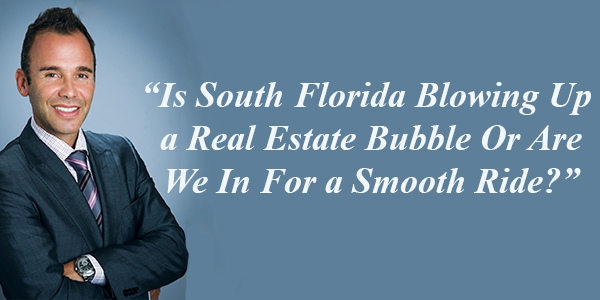
Text Jay Parker / Photo Courtesy of Douglas Elliman
“I see a smooth ride and a long road ahead of us before we enter into a traditional downward cycle.”
The Great Recession was the culmination of the Perfect Economic Storm. Never before in U.S. History have we seen the simultaneous collapse of the banking, automotive and real estate industries coupled with the complete meltdown of our country’s largest financial institutions. When people talk about a real estate market, we typically hear the concept of cycles. In fact, while over the long term real estate has continued to appreciate in value, there have been many cycles throughout our history where real estate values dropped, in some cases more rapidly and aggressively than others. Eventually, at different paces, values recover and the long term growth trajectory resumes. Cyclic activity is normal and in part serves for a correction of the market, creating opportunities for investors, lowering the bar for new home buyers, and serves as a mechanism to halt seemingly unreasonable appreciation. When the South Florida Real Estate Mar- ket imploded in 2007/08, we saw the values of new construction and the single family home market plummet by almost 75% in extremely hard hit segments of the market. South Florida experienced a new development boom where developers sought extremely low deposits with the expectation that the lending environment would stand behind the buyers to make up the balance of the purchase price. Lenders were haphazard in virtually every aspect of the borrower qualification process. It’s hard to imagine the concept of “no doc” loans (loans granted without a borrower having to provide documentation to evidence their ability to actually pay the loan back), but in fact “no doc” loans were a common instrument during the South Florida Real Estate Boom. Anyone with a reasonably good credit score could secure a loan of 95% of the purchase price, simply by making application and signing on the dotted line.
The “no doc” loan and a variety of other predatory loan products allowed funding for buyers who otherwise could not afford the real estate. Similarly, those borrowers who could afford the loan secured such high leverage, that when the bubble burst, there was simply little justification to close on the property – or in many cases to continue to pay the mortgages once values sank to their lows. The power punch of low deposits and high leverage loans to anyone who wanted resulted in the real estate market crash. Today, a mere six years after the crash, the excess inventory has been sold, values have regained their pre-recession values and in many cases have exceeded those values. New construction projects like Faena, Edition, and Park Grove have raised the bar for luxury, and in line with the new luxury, prices have exceeded $3000 per foot and yet amazingly still appear as a significant discount from other major metropolitan cities like NY, London, Shanghai,and others. Some international markets followed the United States economic downturn and unfortunately have seen a slower recovery. The weakness in the international markets,depressed currencies in Brazil, Europe, and Asia, have led many investors to look to the U.S. and in many cases South Florida, as a healthy and safe market for investment and a hedge against their markets1 currency crisis. Taxes in some states are making South Florida more and more compelling. In fact, South Florida is benefitting from a significant transfer of wealth from the NY metropolitan area. The savings of no state income tax, lower sales tax, the cost of real estate, private schools and rental costs for commercial space, combined with the exciting explosion of the art, culture, restaurants and community, not to mention the weather, have created a significant flow of wealthy New Yorkers calling south Florida Home. Today’s market is very different than the mar- ket the led us to the bust.
Today’s developers are seeking significant deposits, which in many cases are 50% of the purchase price. The developers are seasoned professionals who build well, build fast and know that they are being held to a higher standard when designing and finishing their product. Lenders are back, but today1s lending environment is appropriately guided by underwriting guidelines that protect consumers while at the same time ensuring that loans are granted based upon both assets and income. Buyers are increasingly recognizing South Florida as a great second home location, a good investment market and a great place to live. From Art Basel, to the Perez Art Museum, the New World Symphony to the Frost Museum of Science, South Florida offers it all, and our skylines will ultimately reflect the same character, sophistication and elegance that its residents posses. Today, South Florida is “the place to be”, and so I say “build it and they will come.” As the CEO of Douglas Elliman Florida, we have been ramping up our team to continue to grow with the South Florida Real Estate Market and we see sunny skies in our future.