
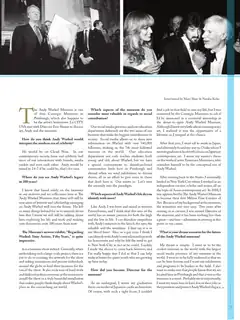
The Andy Warhol Museum is one of four Carnegie Museums in Pittsburgh, which also happens to be the artist’s hometown. Le CITY USA met with Director Eric Shiner to discuss art, Andy and the museum.
How do you think Andy Warhol would interpret the modern era of celebrity?
He would be on Cloud Nine. In our contemporary society, fame and celebrity fuel most of our interactions with brands, media outlets and even each other. Andy would be tuned in 24-7 if he could be, that’s for sure. Where do you see Andy Warhol’s legacy in 100 years?
I know that based solely on the treasures in our archives and art collections here at The Andy Warhol Museum, that there will still be new areas of interest and scholarship emerging on Andy Warhol well into the future. He left so many things behind for us to unearth about him that I know we will still be talking about him, exploring his life and work and making new discoveries even 100 years from now. The Museum’s newest exhibit, “Regarding Warhol: Sixty Artists, Fifty Years,” is quite impressive.
Which aspects of the museum do you consider most valuable in regards to social contribution?
Our social media presence and our education department definitely are the two areas of our business that make the biggest contributions to society. Social media allows us to share new information on Warhol with over 540,000 followers, making us the 7th most-followed museum in the world. Our education department not only teaches students, both young and old, about Warhol, but we have a special commitment to disenfranchised communities both here in Pittsburgh and abroad when we send exhibitions to distant shores, all in an effort to give voice to those that don’t have it. Our motto is: Let’s turn the anomaly into the paradigm.
Which aspects of Andy Warhol’s life do you identify with most?
Like Andy, I was born and raised in western Pennsylvania, and I think that this area of the world has an innate passion for both the high and the low in life. I can therefore empathize with Andy’s interests in the kitsch, the rare, the valuable and the mundane. I dare say it is in our blood here! Also, as a gay man I think I can identify with Andy’s own relationships with his hometown and why he felt the need to get to New York City as fast as he could. Luckily, I made the choice to come back however, and I’m really happy that I did so that I can help make it better for queer youth who are growing up here today.
How did you become Director for the museum?
As an undergrad, I wrote my graduation thesis on medieval Japanese castle architecture. Of course, with such a tight focus, I couldn’t
find a job in that field to save my life, but I was contacted by the Carnegie Museums to ask if I’d be interested in a curatorial internship at the about-to-open Andy Warhol Museum. Although I knew very little about contemporary art, I realized it was the opportunity of a lifetime, so I jumped at the chance.
After that year, I went off to work in Japan, and ultimately found my way to Osaka where I went to graduate school with a focus on Japanese contemporary art. I wrote my master’s thesis on the work of artist Yasumasa Morimura, who considers himself to be the conceptual son of Andy Warhol.
After moving back to the States, I eventually landed in New York City where I worked as an independent curator, scholar and writer, all on the topic of Asian contemporary art. In 2008, I was approached by The Andy Warhol Museum to become their first Milton Fine Curator of Art. Because of my background at the museum, the transition was very easy. Two years after coming in as curator, I was named Director of the museum, and it has been nothing less than a great—and fun—adventure in arriving at this point in my career.
What is your dream scenario for the future of the Andy Warhol museum?
My dream is simple: I want us to be the coolest museum in the world with the largest social media presence of any museum in the world. I want us to be fully endowed so that we can be here forever, and I want our exhibitions and programs to be leaders in the field. I also want to make sure that people know that we are located here in Pittsburgh and that a visit to the museum is a must. Probably most importantly, I want my team here to have fun in their jobs as they promote and protect Andy Warhol’s legacy.
Vol 1 Spring 2013
It is a fantastic show indeed. Generally, when undertaking such a large-scale project, there is a ton to do in securing the artwork for the show and asking institutions and private individuals around the globe to lend their treasures for the run of the show. It also took tons of hard work and dedication from everyone at the museum to install the show in a truly beautiful installation that makes people think deeply about Warhol’s place in the overarching art world.