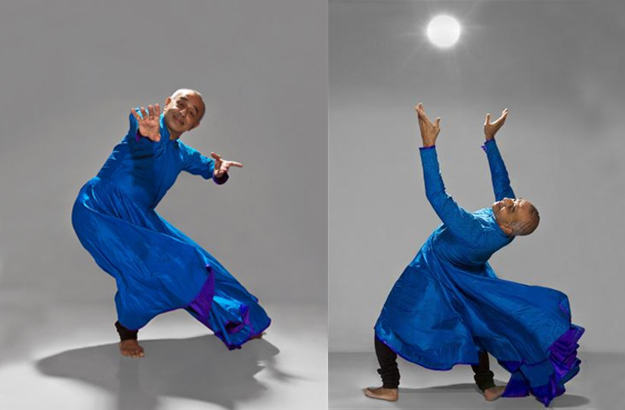
Astad Deboo is often regarded, amongst the order of illustrious artistes in whom he ranks, as the ‘father of Indian contemporary dance.’ Deboo’s journey from a six-year-old child who was smitten with dance, to a Padma Shree awardee and noted danseuse has been anything but ordinary: it has involved, at different periods of his life, hitchhiking across numerous countries, and sharing the stage with iconic cult bands like Pink Floyd. DELHI Deluxe caught up with this doyen of modern dance after his latest production – ‘Interpreting Tagore,’ – ran to a full house in the Capital.
“Iperformed in Delhi after four years,” says Astad Deboo referring to the latest production which his troupe – comprising of young people from Delhi based NGO Salaam Balak Trust – staged at the Kamani Auditoriumlast week.
Life’s finally come full circle from the time a young Deboo decided to pack his bags, stow himself on a cargo ship and hitchhike his way through Europe to reach the Martha Graham Center of Contemporary Dance in New York to learn dance. (The fact that he never made it to New York on that trip is another matter.)”Dance for me is more than life. I mean I live, I sleep, I drink my work. I’ve dedicated my life, for me it’s a form of expression of my feelings, frustrations, my happiness,” says the veteran.
Deboo started dancing at age six, but was forced to forego his passion by his father to pursue a ‘real’ career. After graduating from Mumbai with an economics degree, Deboo was well on his way to pursuing a career in the field when a chance encounter with the American Murray Louis Dance company in 1967 changed his mind. After watching the Company perform live, Deboo’s bottled-up love for dance resurfaced and he decided to leave the country. “I just was figuring it out, how to leave the country and I had come across a senior, a school friend of mine who had just come back from backpacking in Europe. But that was just a little 3 month thing he did. I packed my backpack and sailed out on a cargo boat on the 23rd of May 1969.”
It wasn’t a short voyage either: Deboo’s journeys took eight long years, “during which I visited many, many countries”, he reminisces. After seeking his fortunes in Iran, Galley (France), Turkey, Greece, Italy even countries like Chile, Columbia, Vietnam, Peru, Venezuela, Mexico, Brazil to name a few, Deboo remained undaunted. “Each day was a wonderful gift, because you never knew who you’d be encountering, who’s going to pick you up, what kind of conversation you are going to have. You know I cherish that entire trip and I would do it all over again. I don’t think there is any dancer who’s taken this route to learn,” Deboo says with a smile.
42 years have elapsed since that trip, and today Deboo has created his own space, a niche in the world of modern dance. After training in London and learning Kathakali under the guidance of Guru E Krishna Panikar, Deboo evolved a unique contemporary dance form which is today attributed to him. Although his work received mixed reviews to begin with, criticism and skepticism slowly gave way to acceptance, and finally appreciation. Performing with the likes of Pink Floyd helped; “That gig just came together because of the organizers. It was a part of a bigger show where they performed and I danced and that was it. And back then Pink Floyd had also just come out with their first album, so they were not as big, you know,” he says unaffectedly.
Over a span of more than 20 years Deboo has also worked with many development organisations and is well known for his work with the deaf and the mute. The dancers in his performances are usually young adults from such organisations who he trains and then works with. Years ago when he saw a group of deaf girls perform in Chennai, he resolved to work with challenged kids. “I don’t like to use the word underprivileged, but these are the people who don’t get the opportunity. So I decided to use myself as a catalyst, to bring the talent, develop it and bring it forward and showcase them. I wanted to prove that given an opportunity, a bit of talent too, and if you are willing to work hard one can pick up the form. Here one has to work very very hard, physically – l have my own standards and I push the envelope, I made no concession for the deaf either,” he says matter-of-factly.
While he does not plan to venture into teaching, Deboo advises all those who want to take up contemporary dance as a career to first train formally in a particular form. While our country has a long way to go (according to him Bollywood is a major distraction as that has usurped the popular interest which was traditionally reserved for classical dance forms)-learning is the first step. “I am still learning. Every day is a learning process. In fact only then an artist will continue to be an artist. The day an artist says, oh I know it all, that’s when your downfall will begin.”
‘Interpreting Tagore’ is Deboo’s tribute to the legendary bard. “In the 90’s I had been asked to go through Tagore’s poems and create a performance around it. When the nation decided to celebrate the 150 years of Tagore I decided to revisit that work of mine and recreate it and add a new piece of work. So it will be an evening comprising of four pieces, which are based either on his songs or poems. It is my interpretation and again the music has nothing to do with Rabindra Sangeet. It’s again a whole range of world music which I have selected.”
Text by Treesha Datta