CULTURE
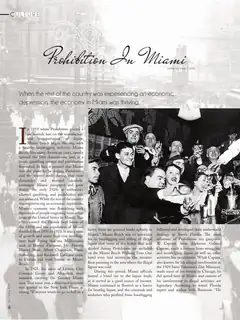
Prohibition In Miami
Written by James Cubby
When the rest of the country was experiencing an economic depression, the economy in Miami was thriving.
Vol 1 Spring 2013
In 1919 when Prohibition placed a nationwide ban on the manufacture and transportation of liquor, Miami Beach began thriving with a healthy bootlegging industry. Miami Beach, like many American cities, openly ignored the 18th Amendment and, as a result, gambling casinos and prostitution flourished. In fact, it seemed that Miami was the place to be during Prohibition and the tourist trade during that time demanded and received alcoholic beverages. Miami prospered and grew during the early 1920s as authorities allowed gambling, and prohibition was not enforced. While the rest of the country was experiencing an economic depression, Miami’s economy was flourishing with thousands of people migrating from other areas of the United States to Miami. This effect caused the Florida land boom of the 1920s and the population of Miami doubled from 1920 to 1923. It was a time of growth and many high-rise buildings were built during this era. Millionaires such as Harvey Firestone, J.C. Penney, Harvey Stutz, Albert Champion, Frank Seiberling, and Rockwell LaGorce came to Florida and built homes on Miami Beach.
In 1925, the areas of Lemon City, Coconut Grove, and Allapattah were annexed, creating the Greater Miami area. That same year, a distressed minister was quoted in the New York Times as saying, “If anyone wants to go to hell in a
hurry, there are greased banks aplenty in Miami.” Miami Beach was so notorious for its bootlegging and selling of illegal liquor that some of the hotels that sold alcohol during Prohibition are included on the Miami Beach Walking Tour. One hotel even had arrows in the terrazzo floor pointing to the area where the illegal liquor was sold.
During this period, Miami officials turned a blind eye to the liquor trade, as it served as a good source of income. Miami continued to flourish as a haven for bootleg liquor, and the criminals and mobsters who profited from bootlegging
followed and developed their underworld dealings in South Florida. The most infamous of Prohibition era gangsters, Al Capone, born Alphonse Gabriel Capone, made a fortune from smuggling and bootlegging liquor, as well as, other activities like prostitution. While Capone, also known for his alleged involvement in the 1929 Saint Valentine’s Day Massacre, made most of his money in Chicago, he did spend time in Miami and rumors of his involvement in illegal activities are legendary. According to noted Florida expert and author Seth Bramson: “He