

A Sunny Place for Shady People
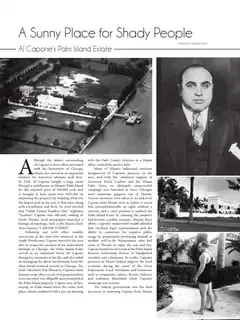
Although the infamy surrounding Al Capone is most often associated with his hometown of Chicago, Miami also served as an important location for America’s ultimate mob boss. In 1928, Al Capone bought a large estate through a middleman on Miami’s Palm Island for the reported price of $40,000 cash, and is thought to have spent over $100,000 on improving the property by building what was the largest pool in the area at that time, along with a boathouse and dock. As word traveled that “Public Enemy Number One,” Alphonse “Scarface” Capone was officially settling in South Florida, local newspapers launched a barrage of warnings, such as the Miami Daily News banner, “CAPONE IS HERE.”
Following suit with other wealthy Americans at the time who wintered in the South Florida area, Capone moved to the area also to escape the excesses of his underworld dealings in Chicago. His Palm Island home served as an important haven for Capone during key moments in his life, and also aided in estranging his direct involvement from the often brutal criminal activity in Chicago. The Saint Valentine’s Day Massacre, Capone’s most heinous coup where seven rival gang members were executed, was allegedly masterminded at the Palm Island property. Capone was, in fact, staying on Palm Island when the crime took place, which combined with a pre-set meeting
with the Dade County Solicitor in a Miami office, created the perfect alibi.
Many of Miami’s influential residents disapproved of Capone’s presence in the area, and with the combined support of Governor Doyle Carlton and the Miami Daily News, an ultimately unsuccessful campaign was launched to force Chicago’s most notorious gangster out of Florida. Various measures were taken to try and evict Capone from Miami such as orders to arrest him unconstitutionally on sight, without a warrant, and a court petition to padlock his Palm Island home by claiming the property had become a public nuisance. Despite these efforts, Capone’s underworld wealth afforded him excellent legal representation and the ability to counteract his negative public image by, propitiously portraying himself as another well-to-do businessman who had come to Florida to enjoy the sun and fun. Capone hosted social events at his Palm Island fortress, welcoming dozens of handpicked socialites and columnists. In reality, Capone’s presence in Miami helped support the local economy during the onset of the Great Depression. Local merchants and businesses such as restaurants, tailors, florists, bakeries and icehouses flourished when Capone’s entourage was in town.
The federal government was the final successor in removing Capone from Miami