

in 1932, albeit temporarily, when he was imprisoned for failure to pay over $1 million in income taxes. Liens were placed on the Palm Island estate for around $52,000, and although the government attempted to sell the property three times to satisfy the unpaid liens, each time Capone’s wife or brother came up with enough money to save the property. By 1938, Al Capone’s mental state had deteriorated due to the onset of neurosyphilis that prison doctors deemed him a mental patient, and in 1939, he was released from Alcatraz, having served seven years of his sentence. Capone returned to his Palm Island home where he lived out his final days, bedridden and increasingly weak and incoherent. On January 25, 1947, Capone died in an upstairs bedroom of the property from cardiac arrest, just shy of forty-eight years old.
Much like Al Capone’s legacy, his
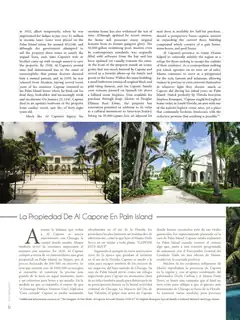
onetime home has also withstood the test of time. Although updated by recent owners, the home still possesses many original features from its former gangster glory. The 60,000-gallon swimming pool, massive even by contemporary standards, was originally filled with saltwater from the bay and has been updated yet visually remains the same. At the front of the property stands an iconic grotto that was much beloved by Capone and served as a favorite photo-op for family and guests to the home. Within the main building, a small bathroom retains all original black and gold tiling fixtures, and the Capone Family crest remains painted on Spanish tile above a billiard room fireplace. Now available for purchase through Jorge Alonso of Douglas Elliman Real Estate, the property has renovation potential in addition to its value as a cultural monument to American history. Sitting on 30,000-square-feet, an adjacent lot
next door is available for half-lot purchase, should a prospective buyer express interest in expanding the current three building compound which consists of a gate house, main house, and pool house.
Al Capone’s presence in South Florida helped to culturally solidify the region as a refuge for those seeking to escape the realities of their existence. As a cosmopolitan melting pot which operates on its own set of rules, Miami continues to serve as a playground for the rich, famous and infamous, allowing visitors to portray or even reinvent themselves in whatever light they choose, much as Capone did during his initial years on Palm Island. Stated perfectly by Florida historian Stephen Bousquet, “Capone might feel right at home today in South Florida, an area with one of the nation’s highest crime rates, yet a place that continually beckons Americans with the seductive promise that anything is possible.”*
La Propiedad De Al Capone En Palm Island
Vol 1 Spring 2013
Españolunque la infamia que rodea a Al Capone se asocia mayormente con Chicago, la ciudad donde residía, Miami también sirvió de escenario importante al máximo jefe mafioso. En 1928, Al Capone compró a través de un intermediario una gran propiedad en Palm Island, en Miami, por el precio declarado de $40 000 en efectivo. Se cree que invirtió más de $100 000 en arreglos al inmueble al construir la piscina más grande de la zona en aquel momento, junto a un cobertizo para botes y un muelle. En la medida en que se expandía el rumor de que “el Enemigo Público Número Uno”, Alphonse “Cara cortada” Capone se estaba asentando
oficialmente en el sur de la Florida, los periódicos locales lanzaron un bombardeo de advertencias, como la que hizo el Miami Daily News en un titular a toda plana: “CAPONE ESTÁ AQUÍ”.
Siguiendo el ejemplo de otros americanos ricos de la época que pasaban el invierno en el sur de la Florida, Capone se mudó a la zona para escapar también de los excesos de sus negocios del bajo mundo de Chicago. Su casa de Palm Island sirvió como un refugio importante para Capone en momentos clave de su vida y también ayudó para distanciarlo de su participación directa en la brutal actividad criminal de Chicago. La Masacre del Día de San Valentín, el golpe más atroz de Capone
donde fueron ejecutados siete de sus rivales gansteriles, fue supuestamente planeado en la casa de Palm Island. Capone estaba realmente en Palm Island cuando ocurrió el crimen algo que, junto a una reunión programada de antemano con el Procurador General del Condado Dade en una oficina de Miami, resultó ser la coartada perfecta. Muchos de los residentes influyentes de Miami reprobaban la presencia de Capone en la región y, con el apoyo combinado del gobernador Doyle Carlton y el Miami Daily News, se lanzó una campaña que al final no tuvo éxito para obligar a que el gánster más prominente de Chicago se fuera de la Florida. Se tomaron varias medidas para procesar
*Additional information courtesy of, “The Gangster in Our Midst: Al Capone in South Florida, 1930-47,” by Stephen Bousquet. Special thanks to Edward Mehnert and Jorge Alonso.