

Between the Spider and the Lamp M. F. Hussain In conversation with Yashodhara Dalmia Yashodhara Dalmia is an art historian and curator in New Delhi who’s an expert on the Progressive Artists group.
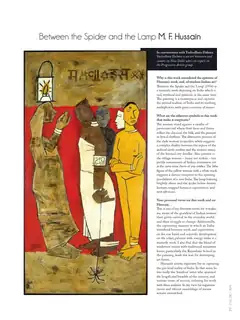
Why is this work considered the epitome of Hussain’s work, and, of modern Indian art? ‘Between the Spider and the Lamp’ (1956) is a masterly work depicting an India which is real, mythical and symbolic at the same time. The painting is a masterpiece and captures the myriad realities of India and its seething multiplicities with great economy of means.
What are the inherent symbols in this work
that make it enigmatic?
The women stand against a swathe of passionate red where their faces and forms reflect the classical, the folk, and the peasant in lyrical rhythms. The alternative persona of the dark woman in spotless white suggests a complex duality between the repose of the archival earth-mother and the anxious stance of the harried city dweller. Also present is the village woman – heavy yet mobile – her profile reminiscent of Indian miniatures yet at the same time shorn of any artifice. The lithe figure of the yellow woman with a white mask suggests a dancer receptive to the opening possibilities of a new India. The lamp burning brightly above and the spider below denote humans trapped between superstition and new advances.
Your personal views on this work and on
Hussain…
NOV — DEC 2012
This is one of my favourite works for it makes me aware of the grandeur of Indian women: their gritty survival in the everyday world, and their struggle to change. Additionally, the captivating manner in which an India transfixed between myth and superstition on the one hand, and scientific development on the other, pulsates with energy make it a masterly work. I also find that the blend of modernist means with traditional miniature forms, particularly the Rajasthani School in the painting, leads the way for developing art forms.
Hussain’s artistic ingenuity lies in capturing the gut-level reality of India. In that sense he was really the ‘barefoot’ artist who spanned the length and breadth of the country, and various strata of society, infusing his work with these realities. In my view his expansive vision and vibrant assemblage of means remain unmatched.