

DIALOGUE
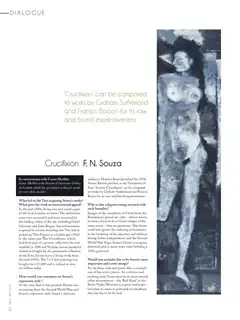
‘Crucifixion’ can be compared to works by Graham Sutherland and Francis Bacon for its raw and brutal expressiveness.
Crucifixion F. N. Souza In conversation with Conor Macklin Conor Macklin is the director of Grosvenor Gallery in London which has specialised in Souza’s works for over three decades.
What led to the Tate acquiring Souza’s works?
What gives his work an international appeal?
In the mid 1950s, Souza was very much a part of the local London art scene. His exhibitions were very successful and were reviewed by the leading critics of the day including David Sylvester and John Berger. Several museums acquired his works including the Tate which picked up ‘Two Figures in a Landscape’ (1961) in the same year. The ‘Crucifixion,’ which had been part of a private collection, became available in 1998 and Nicholas Serota decided it should be bought for the permanent collection as the Tate did not have a Souza work from the mid-1950s. The 7 x 5 foot painting was bought for £15,000 and is valued at over £2 million today.
NOV — DEC 2012
How would you comment on Souza’s
expressive style ?
At the time that it was painted, Britain was
recovering from the Second World War, and
Souza’s expressive style found a welcome
audience. Herbert Read described the 1958 Venice British pavilion as the ‘Geometry of Fear.’ Souza’s ‘Crucifixion’ can be compared to works by Graham Sutherland and Francis Bacon for its raw and brutal expressiveness.
Why is this religious image treated with
such brutality?
Images of the crucifixion of Christ from the Renaissance period are calm…almost serene, however if you look at Goya’s images of the same scenes – they are gruesome. Also Souza could not ignore the suffering of humanity in the backdrop of the atrocities and violence during India’s independence and the Second World War. Ergo, Souza’s Christ is in agony, distorted, and in many ways more befitting a 1950s portrayal.
Would you consider this to be Souza’s most important and iconic image?
For its sheer scale and power this is certainly one of his iconic pieces. As a diverse and evolving artist Souza went on to create several other masterpieces – the ‘Red Road’ in the Kiran Nadar Museum is a great landscape – but when it comes to portrayals of crucifixion this one has to be his best.