

GOURMET
1135AD
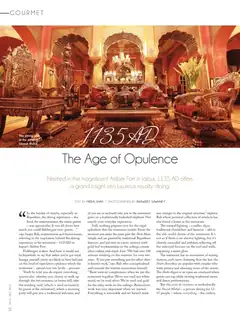
The sitting area at the all-silver Sheesh Mahal.
The Age of Opulence Nestled in the magnificent Amber Fort in Jaipur, 1135 AD offers a grand insight into luxurious royalty dining. TEXT BY MERAJ SHAH / PHOTOGRAPHED BY BHAWJEET SAWHNEY
NOV — DEC 2012
“
In the heyday of royalty, especially in Rajasthan, the dining experience – the food, the entertainment, the entire gamut – was spectacular. It was all about how much you could flabbergast your guests…” says Sanjiv Bali, restauranteur and businessman, referring to the inspiration behind the dining experience in his restaurant – 1135AD in Jaipur’s Amber Fort.
Flabbergast it does. And how: it would not be hyperbolic to say that unless you’ve got royal lineage yourself, you’re not likely to have laid eyes on the kind of superlative opulence which the restaurant – spread over two levels – presents. Truth be told, you do expect something spectacular: whether you choose to walk up through the fort entrance, or better still, take the winding road (which is used exclusively by guests at the restaurant), where a receiving party will give you a traditional welcome, and
(if you are so inclined) take you to the restaurant gates on a traditionally bedecked elephant. Not exactly your everyday experience.
Still, nothing prepares you for the regal splendour that the restaurant exudes. From the moment you enter the patio past the Shila Mata temple and are greeted by traditional Rajasthani dancers, and led into an exotic interior with gold-leaf workmanship on the ceilings, ornate silver cutlery, and objets d’art. “We had over 100 artisans working on the interiors for over two years. If you put something just for effect then it doesn’t work,” says Bali who conceptualised and oversaw the interior restoration himself. “There were no compromises when we put the restaurant together. We’ve not used any white metal, we’ve used silver. We’ve used real gold for the inlay work on the ceilings. Restoration work was very important when we started. Everything is removable and we haven’t made
any changes to the original structure,” explains Bali whose personal collection of artefacts has also found a home in the restaurant.
The natural lighting – candles, diyas, traditional chandeliers and lanterns – add to the old-world charm of the restaurant. It’s not as if there is no electric lighting, but it’s cleverly concealed and ambient, reflecting off the mirrored frescoes on the roof and walls, imparting a warm glow.
The restaurant has an assortment of seating sections, each more charming than the last: the Shahi Jharokhas are popular with couples who want privacy and stunning views of the sunset.
The Shahi Angan is an open-air courtyard where guests can sup while viewing traditional music and dance performances.
But the pièce de résistance is undoubtedly the Sheesh Mahal – a private dining for 1215 people – where everything – the cutlery,