

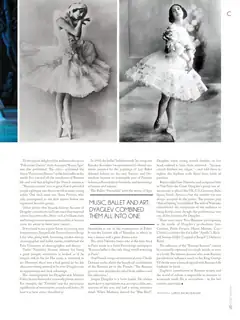
In 1910, the ballet “Scheherazade” by composer Rimsky-Korsakov became famous. Colorful costumes inspired by the paintings of Lev Bakst debuted fashion on the east. Exotics and Orientalism became an inalienable part of Parisian fashion, reflected also in hairstyles and furnishings of homes and saloons.
The Ballet “Petrushka” with the music of Igor
Music, ballet and art: Dyagilev combined them all into one.
Stravinsky, is one of the masterpieces of Fokin.
It was the favorite role of Nijinskiy, in which he was a dancer and a great drama actor.
The artist Valentin Serov who at the time lived in Paris wrote in a Saint Petersburgs newspaper: “Russian ballet is the only thing worth watching in Paris”.
And French composer and musical critic Claude Debussy spoke about the beneficial contribution of the Russian art to the French: "The Russian gives us new impulses for relief from stiffness and the ridiculous."
Sergey Dyagilev is a born leader. He always knew how to spot talent, was an impeccable connoisseur of the arts, and had a strong attention detail. When Markova danced the "Blue Bird",
Dyagilev, when seeing ostrich feathers on her head, ordered to have them removed - "because ostrich feathers are vulgar," - and told them to replace the feathers with those from birds of paradise.
Benua called him Hercules and compared him to Tsar Peter the Great. Dyagilev’s group was often on tour in places like UK, U.S, Germany, Italy, Spain, South America, but the novelty was not always accepted by the public. The premier play “Rite of Spring”was disliked.The wife of Nijinisky remembered the complaints of the audience as being hostile, even though this performance was one of the favorites for Dyagilev.
There were many Non-Russians participating in the works of Dyagilev’s productions: Jean Cocteau, Pablo Picasso, Henri Matisse, Coco Chanel (costumes for the ballet "Apollo"), Richard Strauss (ballet "Legend of Joseph"), Debussy, Ravel.
The influence of the "Russian Seasons" cannot be accurately expressed in a single article, or even in a book. The famous dancers who took Russian pseudonyms’ influence reach so far, King George VI’s bride wore a dress designed with Russian folk tradition in mind.
Dagilev’s contribution to Russian society and the world of culture is impossible to measure or accurately retell. He is everywhere - in the last century and today INTERVIEW LUBOV KHOROSHILOVA
AUTUMN 2012
To the special delight of the audience, the dance "Polovtsian Dances" from the opera “Knyaz Igor” was also performed. The critics acclaimed the dance "Polovtsian Dances" as the best ballet in the world. You can feel all the unruliness of Russian life and soul that delighted the French audience. “Russian seasons” was so great that it provided people a glimpse into the art world to many young artists. One such artist was Anna Pavlova, who only participated in the first season before she organized her own group.
Other artists who became famous because of Dyagilev’s seasons would leave once they received a more lucrative offer. After such a brilliant start, and having become known to the public, it became easier for artists to build their careers. It was hard to see a great future in a young man from province, Sergey Lifar. Famous later as Serge Lifar who, along with, becoming a ballet dancer, choreographer and ballet master, established the Paris University of choreographer and dances. Vazlav Nijiniskiy became famous for being a great jumper, sometimes it looked as if he hanged still in the air. His name is immortal in art. However, there was a bad period in his life when everything seemed to be over. Dyagilev saw an opportunity and took advantage.
The choreographer for Dyagilev was Michael Fokin, he was famous for unusually plastic dances. For example, the “Firebird” was the miraculous equilibrium of movements, sounds and forms. At least it is how critics described it.